Queen Anne's Gate
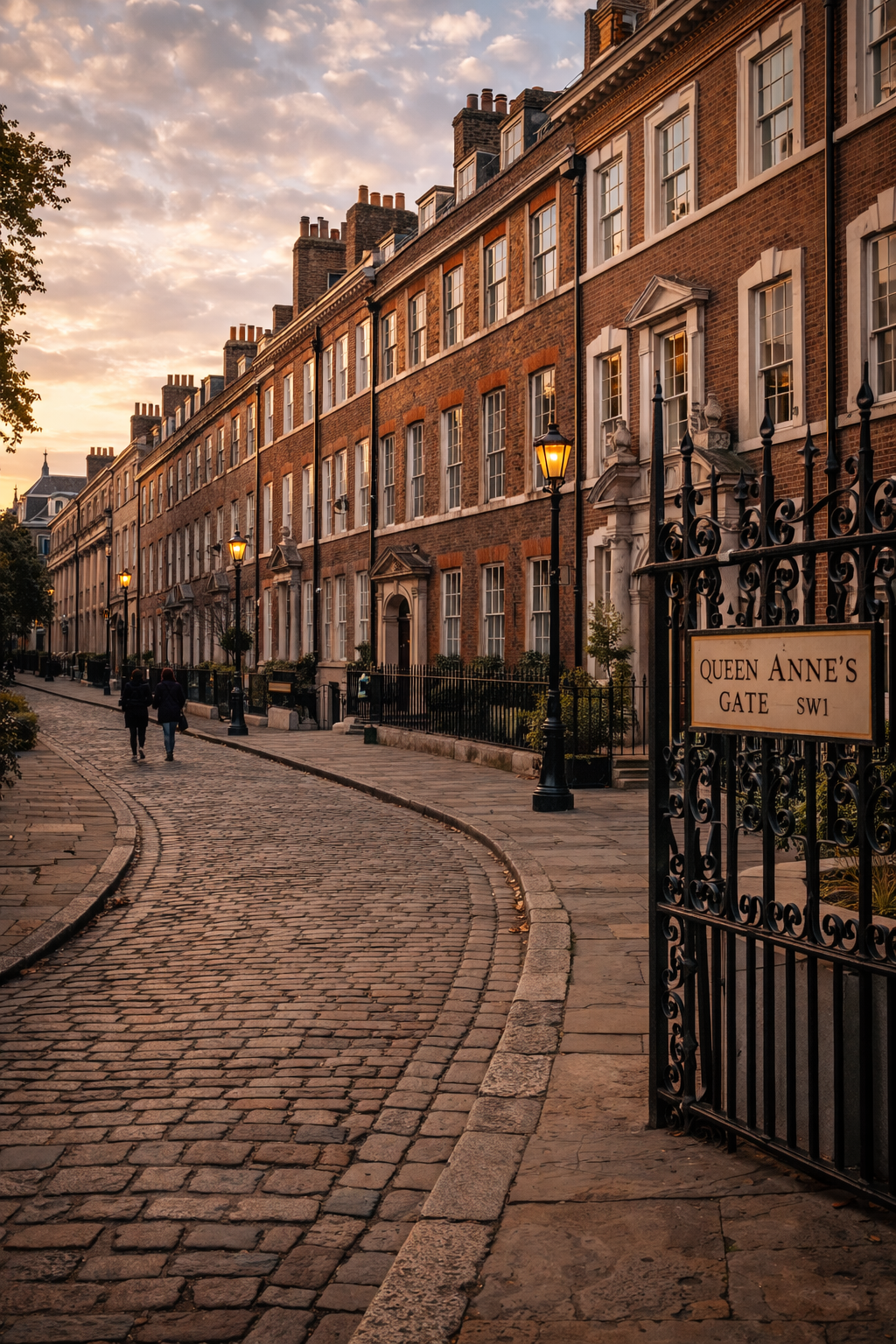
A Georgian Time Capsule
Queen Anne's Gate is one of London's most perfectly preserved early Georgian streets, offering visitors a rare glimpse into the elegant residential architecture of the early 18th century. The street's remarkably complete ensemble of townhouses, dating primarily from 1704, transports visitors back to the reign of Queen Anne, the last Stuart monarch.
Historical Development
The street was developed in two phases. The western portion, originally called Park Street, was built around 1704, while the eastern section dates from the 1770s. The two parts were united in 1873 and renamed Queen Anne's Gate in honor of the statue of Queen Anne that stands in the street. This statue, carved around 1705, depicts the queen in her coronation robes.
Architectural Features
The houses of Queen Anne's Gate exemplify the restrained elegance of early Georgian domestic architecture. Built of brown brick with red brick dressings, they feature the characteristic elements of their period: tall sash windows, ornate wooden doorways with carved canopies, and wrought-iron railings. Many retain their original torch extinguishers—iron cones beside the doorways where link boys would extinguish their torches after lighting residents home through the dark streets.
The Doorways
Perhaps the most striking features of Queen Anne's Gate are its magnificent doorways. Each entrance is topped by an elaborate carved wooden canopy, supported by scrolled brackets and featuring unique decorative details. These canopies, some of the finest surviving examples in London, demonstrate the high level of craftsmanship available to wealthy Georgian householders.
Notable Residents
The street has been home to numerous distinguished residents over the centuries. Lord Palmerston, twice Prime Minister, lived at Number 20 in the mid-19th century. Admiral Lord Fisher, the naval reformer, resided at Number 16. The street's proximity to Parliament and government offices made it a natural choice for politicians, civil servants, and those connected with the corridors of power.
The Blue Plaques
Several buildings on Queen Anne's Gate bear blue plaques commemorating their famous residents. These markers, part of London's oldest systematic commemorative scheme, help visitors identify the historical significance of individual houses and connect the architecture to the people who shaped British history.
Preservation
Queen Anne's Gate owes its remarkable state of preservation to both good fortune and deliberate conservation efforts. The street escaped the bombing of World War II that devastated much of Westminster, and it was designated a Conservation Area, ensuring that its unique character is protected for future generations.
Modern Westminster
Today, Queen Anne's Gate remains a mix of residential properties and offices, many occupied by organizations connected with government and public affairs. The street retains its peaceful, almost village-like atmosphere, offering a striking contrast to the busy thoroughfares nearby.
Visiting Today
Queen Anne's Gate is freely accessible to pedestrians and offers one of the best opportunities in London to experience authentic early Georgian streetscape. The street is located just south of St James's Park, making it easy to combine a visit with a walk through the park or a tour of Westminster's other historic sites. While the houses are private residences and offices, their exteriors can be admired from the street.
Opening Hours
Public Street: Always accessible
Free to visit. Please respect that the houses are private residences and offices. Best viewed during daylight hours.